TRADITIONAL CRAFTS

How to Read a Goshuin The One Page That Is Never the Same Twice
◆
◆
◆
Date updated : 2026/08/13
Months from now, you will open this book at home and a single page will hand you back a whole day. The
weather. The gravel you crossed. What you were quietly hoping for when you stood in front of the hall. That
is what a goshuin does, once you know how to read it; and reading it is the small skill I want to leave with
you here, so that the next page you carry home is never just a souvenir.
Not a Stamp — What You’re Actually Holding
There is one thing worth clearing away first, because almost everyone arrives believing it. A goshuin
is not a stamp. It is not the inked block you press yourself at a station or a castle gate to prove
you were there. If you have ever carried a pilgrim’s credential along a European way, collecting its
stamps church by church, you already know part of the impulse, though here the mark is brushed by a
human hand, and no two ever fall the same way.
What you are holding is a record of having paid respects: the mark of a moment of connection with the
Buddha or the kami, the sacred presences of that place, made in ink and vermilion by a person’s hand.
At temples the fee is often called nōkyōryō, the “sutra-copying offering,” and the name itself hints
at its origins: the practice is said to go back to the days when pilgrims would hand-copy a sutra,
offer it, and receive a receipt in return. The copying has fallen away at most places. The receipt,
transformed, is the page in front of you.
Which leads to the one line at the heart of it all: no two are ever the same. The design differs
from one temple or shrine to the next, and even the same place, on a different day, in a different
hand, gives you a different page. It is not a reprint of a keepsake, but a record made once, here,
and never again in quite the same way.


The Grammar of the Page — How to Read the Page
So where does your eye go? Once you know the order, a page that seemed unreadable a minute ago starts
to speak.
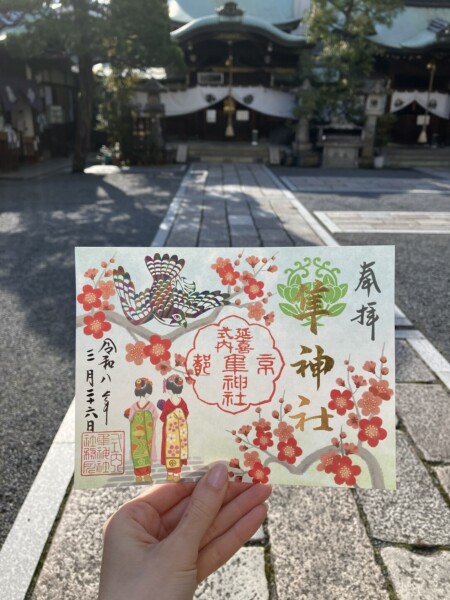
Start in the top right. That is usually where you’ll find hōhai: three or four characters expressing
the idea, “I have humbly visited.” It is the page introducing itself, in the register of someone
bowing at the threshold.
Then the center, in bold black ink. This is the heart of the page, and it is also the quiet answer to
the question every traveler asks sooner or later: when receiving a goshuin, what actually differs
between a shrine and a temple? At a temple, the central ink most often names the enshrined Buddha, or
the sacred rank of a pilgrimage hall. At a shrine, it names the shrine or the deity. The difference
does not require a course in Japanese religion to appreciate; it is there to be seen. One reads as a
name you might sound out; the other tends to arrive as something denser, more layered, less
immediately legible. There is a reason for that density, as you’ll see in a moment.
Then down to the left: the date you visited, the name of the temple or shrine in ink, and its seal.
Right, then center, then left; top to bottom: that is the whole grammar of it.
It is best experienced with your own eyes, on your own page, standing where you received it, rather
than approached as a checklist. Follow that path once, and the pattern stays with you for every page
after.

Inside the Red — The Vermilion You Cannot Read
Now for the part that is easy to overlook: the large red seal in the center, which can seem almost
decorative if you cannot read it.
In most cases, this is because it isn’t written in a form meant to be read at a glance. Inside that
vermilion, you will often find a name. At a temple it may be a bonji, a single syllable in an ancient
Indian script, a seed-letter that stands in for the enshrined Buddha. In Zen temples you may instead
meet the sanbōin, the Three Treasures: “Buddha, Dharma, Sangha,” carved in tensho, an archaic seal
script so old and so folded in on itself that even most Japanese readers cannot decipher it.
The mark that can look like a pretty red flourish is, quite possibly, the most sacred thing on the
page: the name of a god or a Buddha, written in a script whose beauty is part of what makes it
difficult to read. This is the whole difference between glancing and reading. And it is where the
shrine-and-temple question finally settles into your hands, not as a fact you were told but as
something you can see: a shrine’s seal tends to sit more openly, the shrine’s name or crest almost
legible, sometimes with a season’s motif drawn around it. A temple’s seal keeps its meaning folded up
inside a shape. Once you’ve noticed it once, you can’t un-notice it: every red seal after this becomes
a small closed door with a name behind it.
There is no need to decode every one; half the pleasure is knowing a name is in there and letting it
stay slightly out of reach. That is a very Kyoto kind of knowing.


The Hand — The Hand Behind the Brush
Here is where a goshuin stops being an object and becomes a person’s work.
The brushwork — the pressure, the speed, the way the whole page is composed in the seconds it takes to
make — is decided by whoever is holding the brush. That is why the same temple gives you a different
page in spring than the one it gave someone in autumn, and a different page again from the next
writer. This is not a flaw in the system. It is the system. The single most loved thing about a
goshuin is exactly that it cannot be reproduced.
If you have ever watched a craftsperson in Kyoto work — a potter, a plasterer, anyone whose hands
carry decades — you already know the feeling that arrives at the desk. It is the same economy of
movement, the same absence of wasted effort, the sense of something practiced so many times that it
has stopped looking like effort at all. You hand over your open book. And then you simply watch: the
black ink laid down in a few unhurried strokes, the red pressed beside it, the contrast of the two
doing quiet, deliberate work on the paper. Only a matter of seconds. You stand there while a page that
will outlast the trip is made in front of you, once.
While the brush is moving, the kindest thing is to let the silence stand, giving it your full
attention. That said, the quiet belongs to the writing, not to some rule of total silence: once the
brush is down, a word of thanks, or a single question about what was just written, is perfectly
welcome. Let the moment itself be what it is: the smallest piece of Kyoto’s craft, made by hand, for
you, today.
The Date — The Date, and the Same Season Next Year
Look again at that date in the lower left. Every goshuin carries one, and that is not bookkeeping; it
is the whole point. It fixes the page to a single day that will not come back.
There’s a subtlety here worth having. If the page was written directly into your book (jikagaki) the
date belongs to that moment and that desk; the day was received on your behalf. But when a place is
busy, or the writer is away, you may instead be given a kakioki, a page written in advance on a
separate sheet. Many places do both, and it’s a perfectly ordinary thing to ask which is available.
With a pre-written page you sometimes fill in the date yourself, which means you are the one deciding
what “today” it belongs to. Neither is lesser. Knowing the difference just lets you read your own page
more fully.
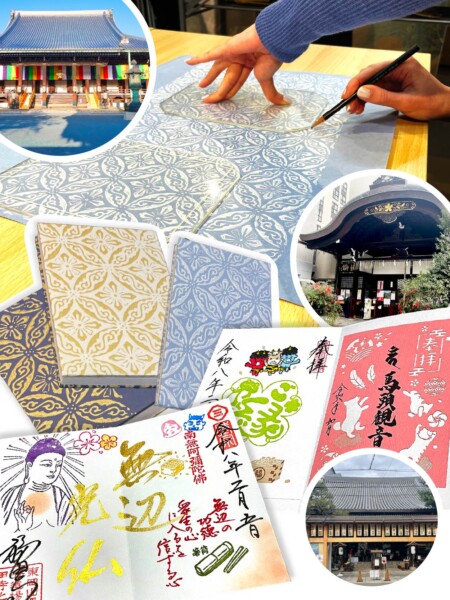
And Kyoto gives the date something to hold onto. Depending on the season, some temples and shrines
offer kirie goshuin for a short window: pages cut from paper into lace-fine designs, such as a
camellia or a weeping cherry tree in spring. And because they’re printed and cut, they come as
pre-written sheets. You may be tempted to chase them like limited editions. But one of the most
meaningful ways is one Kyoto rewards over years: to receive the same place’s page in the same season,
again, and set this year’s beside last year’s. The dates a year apart, the season the same. That small
stack is a way of measuring your own returning; the thing a guidebook can never hand you, because it
only happens to someone who comes back.


– Coming with children.
The manners are the same for every age, which is what makes it teachable. You pay your respects at the
hall first; then, at the desk, you open your book to the page you’d like written and hand it over; and
while the brush is working, those quiet few seconds, you wait. For a child holding their own book,
watching a page get made by hand is the lesson, and no explaining is required. And because every page
is dated, a family’s books quietly become a record of which year you were all here together — the kind
of record a grandchild might one day set beside a grandparent’s, three generations reading the same
seasons back to one another.
Carrying It Home — Reading It Home
None of this is a rule you have to memorize, and I would rather not turn it into a list of
instructions. It’s simpler than that: once you can read a goshuin — the hand, the hidden name, the day
that made it — you don’t have to be told to treat it as more than a stamp collected. You just do,
because you can see what it is.
That’s the skill worth carrying home. And it’s one that keeps paying out later, in a way that’s hard
to feel on a first pass — a few years and a few returns from now, standing at a desk you’ve stood at
before, watching a hand at work that you now know how to read.
Before You Go — A Reader’s Cheat Sheet
| What to look for / do | Why it matters | Good to know |
|---|---|---|
| Hōhai (top right) | “I have humbly visited”; where your eye starts | The page introducing itself |
| Central ink | Temple = the enshrined Buddha’s name; shrine = the shrine or deity | This is your entry point to reading a temple vs. a shrine |
| The vermilion seal | A hidden name: a bonji seed-syllable, or the “Three Treasures” | Temples layer denser seals; shrine seals tend to read more openly |
| The date | Proof of this day | Direct-written = that moment; pre-written = a date you may sometimes fill in yourself |
| Pay respects first | A goshuin is a record of a visit, not a purchase | Go to the main hall first, then the desk; wait quietly while it’s written, and hold questions until the brush is down |
| Direct vs. pre-written | Decides whether the day feels received or self-assigned | Ask: “Could you write directly in my book?” / “Do you have a pre-written goshuin?” (*Kirie pages are pre-written) |
| The book itself (goshuinchō) | You need one before you can receive a brushed page | Sold at many temple and shrine desks (often in their own design) and at stationery shops; commonly around 1,000–3,000 yen. Check locally, as not every place offers one |
| When the desk is open | Pages are brushed only during set hours | Goshuin desk hours can differ from temple or shrine opening hours, sometimes ending earlier. Check locally, especially if visiting near the end of the day |
| How to pay | Small desks rarely take cards | Cash is the norm, and small coins are handy for the offering |
| The offering | This is an offering, not a price | Often around 300–500 yen; double-page, colored, embroidered, or kirie pages more. Fees have been changing; check locally |
| Seasonal / kirie | A season you can carry home | Some places offer specially designed goshuin to reflect the season for a limited time; confirm availability with each place |
Book prices, opening hours, offerings and seasonal dates are given as ranges; these are the details to
check locally, with each place, in the year you travel.
A Model Route — Half a Day, Spent Reading One Page
| Step | Where the eye goes | Why |
|---|---|---|
| 1. Arrive and pay respects | To the main hall or main sanctuary first | The page comes after the visit, not before |
| 2. Watch the brush | To the hand at the desk | Ask for a direct-written page; give the seconds of brushwork your quiet attention |
| 3. Read what you received | Top right → center → lower left, then into the vermilion | Read your own page while you’re still standing there |
| 4. Note the date | To the lower left | Let “today” register: this is the day the page belongs to |
| 5. Come back in another season | To the same place, months later | Receive it again, set the two side by side, and read the time between them |
A note on the ground itself: temple and shrine precincts are rarely flat, and at a
busy desk you may be on your feet in a line for a while. If stairs, slopes, or standing are a
concern, for you or for someone traveling with you, that is exactly the kind of thing worth asking
us before you go.
You might pass a goshuin desk at Tō-ji, at Rokuharamitsu-ji, or at Shimogamo
Shrine.
This is a way of reading rather than a list to complete. The page is the destination, wherever you
receive it.
When you come back to explore that, we’d love to help. Whether that means finding
a
temple where the writer can talk with you, in English, about what the brush just set down, or
simply
steering you to a quieter hour, away from the queue, when the desk has time for you.
Sharing Kyoto Exclusive Goshuin Tours