TRADITIONAL CRAFTS

Before the Gold A Beginner’s Guide to Kintsugi in Kyoto
◆
◆
◆
Date updated : 2026/08/06
For years I could have given you the definition you may know right now: kintsugi, the Japanese
art of mending broken ceramics with gold. I live in Kyoto, and I still had it wrong — because I
had read that sentence many times and never once watched a repair from the
beginning.
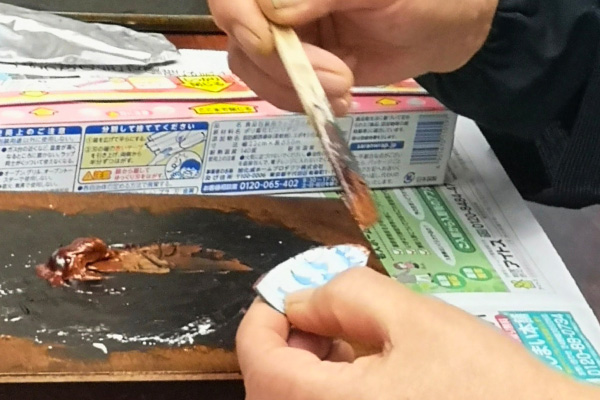
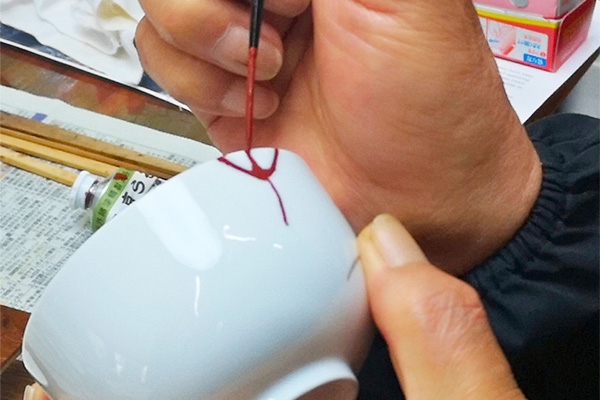
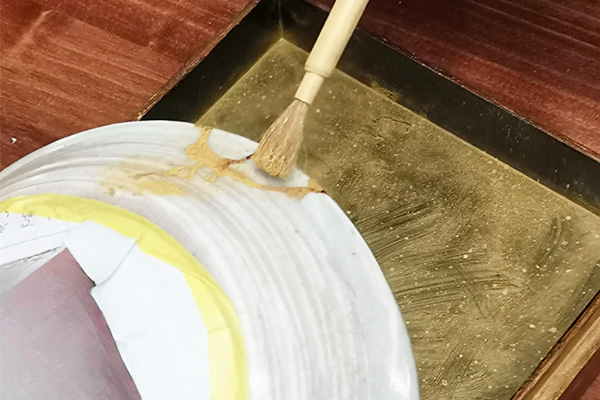
Watch one and count the verbs. The hands join the broken pieces. They fill what is missing. They paint the seam and paint it again. They dust powder over the wet line, and they seal that powder in place. Five verbs, and the first four belong entirely to urushi, the sap of the lacquer tree, worked and rested and worked again for weeks. The gold, when it is gold at all, is a finishing touch over a repair that is already complete underneath.
So, the name points to the wrong material. Kintsugi is not a gold technique; it is a lacquer technique that ends, sometimes, in gold: and what it is, where it came from, how it works, and why this city calls it beautiful, all follow from that one correction.
The gold is the last five minutes.
Watch one and count the verbs. The hands join the broken pieces. They fill what is missing. They paint the seam and paint it again. They dust powder over the wet line, and they seal that powder in place. Five verbs, and the first four belong entirely to urushi, the sap of the lacquer tree, worked and rested and worked again for weeks. The gold, when it is gold at all, is a finishing touch over a repair that is already complete underneath.
So, the name points to the wrong material. Kintsugi is not a gold technique; it is a lacquer technique that ends, sometimes, in gold: and what it is, where it came from, how it works, and why this city calls it beautiful, all follow from that one correction.
The gold is the last five minutes.
Mending was never the rare part
If mending were the marvel, every attic in Europe would hold a kintsugi. It holds
something close. For a couple of centuries, china menders from Amsterdam to London
made steady work of broken porcelain; drilling hairline holes along the crack,
setting metal staples across it, and sending the dish back to the kitchen shelf.
Repair was ordinary household sense. A repaired plate was nothing remarkable – and
certainly nothing to display.
Japan’s side of the story begins much earlier, with the material. Lacquer has been
worked on these islands since the Jomon era, deep in prehistory, and Kyoto’s own
lacquer trade has run for some 1,200 years, refined on commissions from courtiers
and monks and later, from tea masters with exacting eyes, a lineage the state
formally listed as a traditional craft in 1976. The form we now call kintsugi is
younger and harder to date. It is said to have taken shape around the fifteenth
century, inside the tea culture of the Muromachi period. “Said” because nobody wrote
down its date of origin, and this article will not invent one.
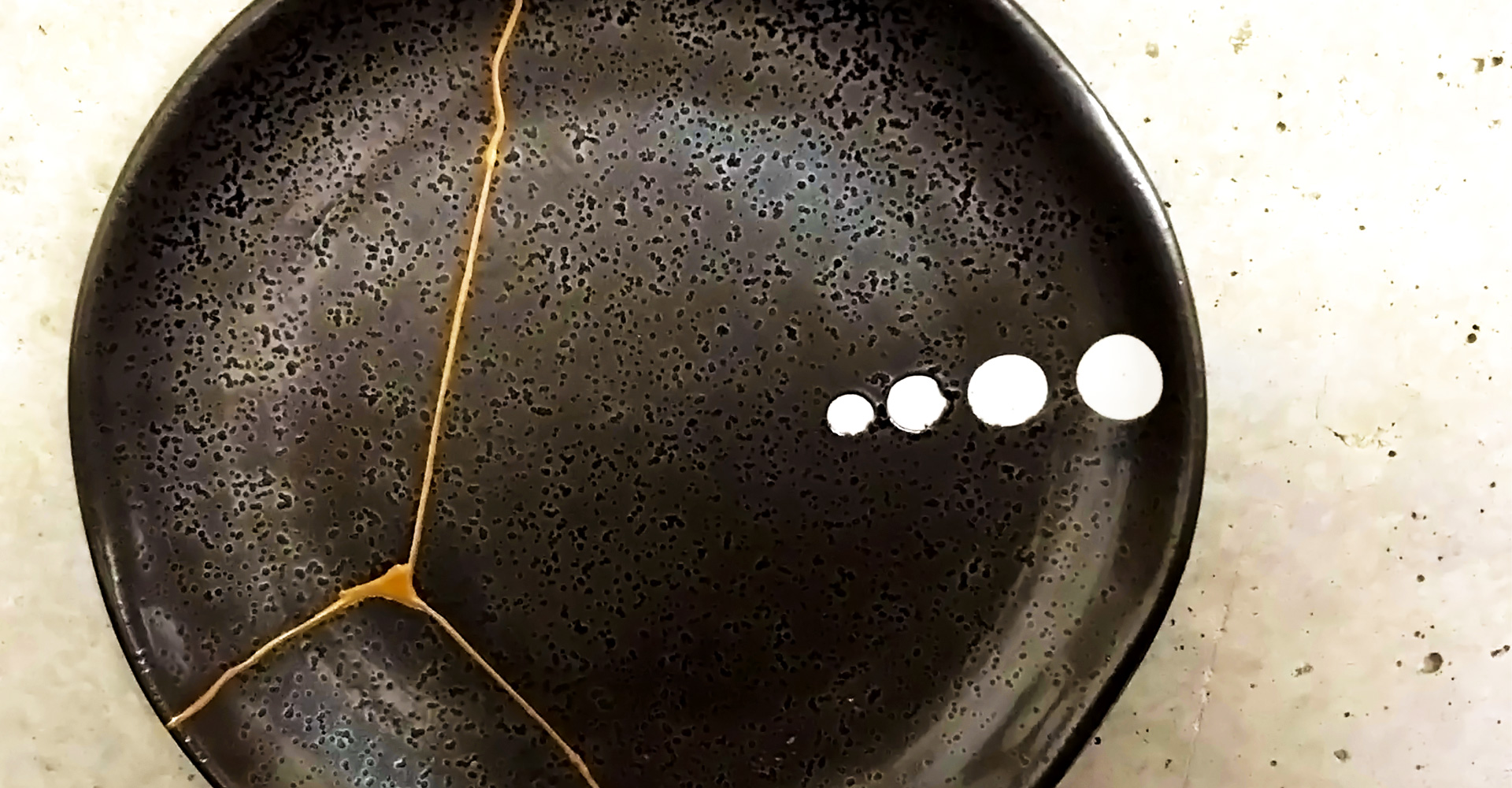
What can be dated is the difference. The European staple said: this dish still
works. At some point, in the tea rooms of this country, a mended seam moved from
the hidden side of the bowl to the viewing side, and the repair began to say
something else: this bowl has been somewhere. Mending was never the rare thing.
The rare thing was deciding to look at it.
Urushi does not dry
Now the part every quick summary skips, which happens to be nine-tenths of the
craft.
Urushi does not dry.
It cures: an enzyme reaction that wants humidity around 80 per cent and a
temperature near 25°C and refuses to be hurried. The sap asks for a humid cabinet,
and for time inside it. So the five verbs at the beginning are really five waits.
The join rests for days before the filling can begin. The fill rests before the seam
can be painted. Each coat rests before the next one will take. Only when that slow,
invisible architecture is finished does anyone reach for the powder. This is why a
repair made the traditional way, real urushi through to real gold, takes roughly two
months and often longer.
Two months, for a seam the width of a hand. It sounds extravagant until you see what
time does: every resting stage is the material binding itself deeper into the clay,
and none of it will ever show. When the piece is done, those weeks sit invisible
beneath one bright line, nine-tenths of the work below the surface, the visible part
a closing gesture. If that proportion feels familiar, you have spent time in Kyoto,
a city that puts its effort where you will not see it and lets the last inch speak.
Kintsugi simply lets you watch the habit on the scale of a single bowl.
One reassurance: only liquid urushi can trouble the skin, hence the gloves on every
workshop bench. Once cured, the vessel is entirely safe to use.
Where the cup comes from
The tree gives its sap once. A lacquer tree grows for roughly ten years before
it can be tapped; over a single season it yields about 180 cc – one cup – and
then, its veins emptied, it is felled that same year. Across a country, the
scarcity becomes official: by the Forestry Agency’s count, restoring Japan’s
national treasures takes about 2.2 tonnes of domestic urushi a year, against a
recent harvest closer to 1.8.
Which makes the next fact worth a slow read. Of the domestic urushi in circulation,
the figure usually given is that more than seven in ten passes through one shop in
Kyoto: Tsutsumi Asakichi, a lacquer merchant founded in 1909, which refines and
blends the raw sap for workshops across the country – and which has been planting
lacquer trees in Keihoku, in the city’s northern hills, for the craftsmen of fifteen
years from now.
The gold end of the work has a Kyoto address too. The dusting gesture – powder
scattered over wet lacquer – is the smallest unit of maki-e, sprinkled-metal
decoration with a lineage all its own: twelve centuries in this city’s hands. By the
prefecture’s reckoning, more than eight in ten of the Buddhist altar fittings in
Japan’s temples are made here, each passing through a lacquerer’s hands. The
material flows through Kyoto, and the hands that understand it are thickest on this
ground. That, not sentiment, is why this repair and this city keep each other’s
company.
“Kintsugi” is one name in a family
So why call a mended seam beautiful? Kyoto’s most honest answer begins by widening
the frame.
Gold is not even the family’s only face.
There are seams of silver, which darken and settle with the years; seams of tin;
repairs in coloured lacquer alone, no metal anywhere. There is yobitsugi – patching
with another vessel’s fragment – so the mended bowl becomes two bowls in
mid-sentence. And there is the oldest member of all: the crack held shut with metal
staples, the answer the European menders gave.
Line the family up and the real decision shows itself. Gold was never the point.
What every member shares – the thing actually chosen, bowl by bowl – is that the
seam stays where eyes can find it. That is the answer to why: not a theory to
recite, but a decision you can see.
The most famous mended object in Japan proves the point precisely because it
contains no gold at all. In the Tokyo National Museum sits a celadon tea bowl that
tradition links to the shogun Ashikaga Yoshimasa. The story – first written down in
1727, centuries after the events it describes – has him sending the cracked bowl
back to China for a replacement; word returned that nothing of its like could be
made any more, and the bowl came home with its crack held by iron staples – a
Chinese answer, arrived at on its own, a lineage apart from the European menders’
staples. The repair, not the bowl, became what people travelled to see. And it is
not kintsugi – no urushi, no gold. It may simply be the best evidence that the eye
that reads a mend as scenery was here before the gold ever was.
In 2025, a museum in this city filled an exhibition with more than eighty tea
utensils, every one of them mended — gold, silver, staples, borrowed fragments.
The show has closed. The shelf it drew from has not.
Where reading stops
All of this you now know, and your hands know none of it – and this is a craft that finally explains
itself through the hands. Kyoto is full of rooms offering to close that gap in a single session; carry
one piece of arithmetic in with you.
There are only three ways to condense two months into a few hours: stop using urushi, stop using gold,
or have someone do the waiting before you walk in. Every session sold in this city is built from those
moves – which is why one name, “Kintsugi Workshop,” covers three kinds of session (modern kintsugi,
one-day urushi, the multi-session class; the table below holds their particulars), and why prices
mostly run ¥8,000–¥20,000 for one and a half to three hours at the time of writing, reaching ¥40,000s
as English support or a master’s own bench enters the arrangement.
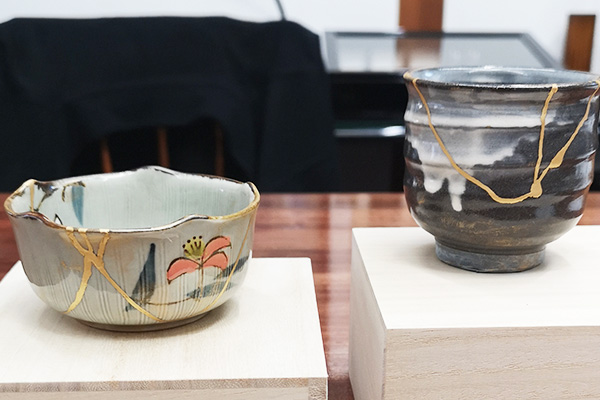
The booking pages will name the kind, if you read their English closely. A
“gold-coloured finish” answers the gold question in a hyphen; “synthetic
lacquer” answers the urushi one; “adapted to allow you to complete your piece
within the session” tells you where the waiting went, and “using urushi
lacquer,” quietly, that it stayed. Where a page does not say, ask across the
table: What are we gluing with? What is the “gold” – real gold powder, gold
leaf, or brass powder? What happens after I take it home? The middle question
has money in it – brass powder runs less than a tenth of real gold powder, and
dulls a little where gold barely moves – and if you mean to eat off the piece,
add a line about the surfaces that will touch food.
The rest is telegraphy. Everything runs on reservation; fix the slot when you plan the trip, not after
you land. Small studios close earlier than the platforms and hold heavier cancellation terms: one
slot, one group, your materials staged for your hands. Some of the most substantive sessions do not
run in English at all: staged materials and working pace cannot idle for interpretation. We have
asked, in Japanese and in English, and have been politely declined more than once.
If children are with you, the lower limit sits around eight to ten – the work is
fine-fingered, and the urushi is real – but write ahead with ages and numbers before
ruling anyone out; some studios will be flexible for a family that asks. Adult
children – university age and upwards – need none of this arithmetic; they take the
bench as any adult does.
Last, the part after Kyoto. A piece mended with real urushi cannot be washed for two
to three weeks while the seam finishes curing; the paulownia box some studios hand
you is not gift wrapping but transport engineering. At home, that one piece will
pass up the dishwasher and ask for your hands.
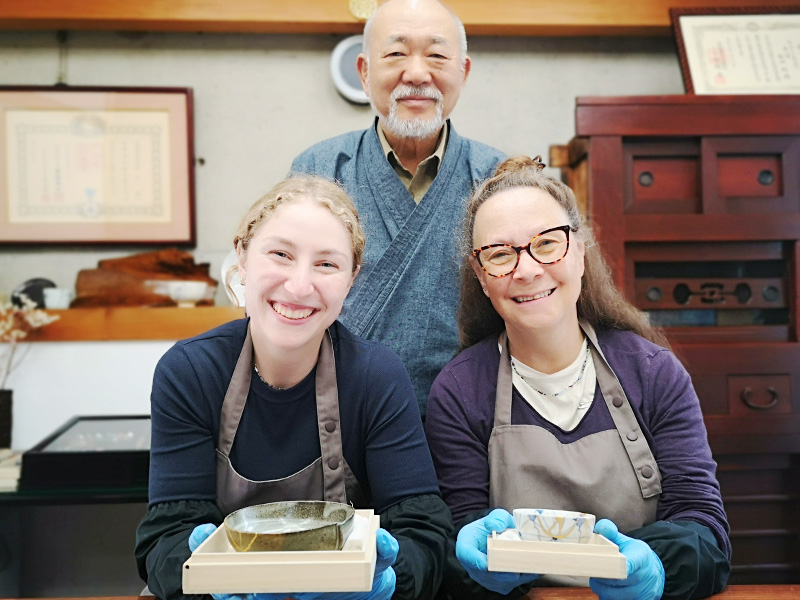
Until the gold comes
Go back to the correction at the top; it is yours now. The next mended bowl that
crosses your path, in a museum case, on a friend’s shelf, you will catch yourself
looking for the line. That eye is the gift of reading. What reading cannot hand over
is the weight of the work in your own fingers.
For that part, we keep one door in mind. In Nishi-suyacho, a quiet block of Shimogyo, a working studio
lacquers Buddhist altars and temple fittings between its lessons, and real urushi and real gold powder
are the standard there. It is the bench of Mr. Tsutomu Matsuda of Matsuda Shikkogei, who has more than
fifty years in the trade. He resolves the two-month problem the honest way – the waiting done before
you arrive, vessels staged at each true stage of a repair, so that your one session passes through the
actual method with nothing removed. His bench takes guests in the morning and in the afternoon alike,
and we have been arranging seats at his table since 2024.
One inconvenient truth belongs here: the type truest to the craft, the multi-session class, does not
fit inside a trip; it belongs to people who live in this city. What a traveller gets is one session –
a morning or an afternoon. If you would like assistance in choosing it, tell us about the piece you
hope to mend, and we will direct you to the correct side of the table.
The gold, as always, comes last. Everything before it can begin now.
Before You Go
The three types, side by side
| What to ask | Modern kintsugi | One-day urushi | Multi-session class |
|---|---|---|---|
| What holds it together? | Food-safe synthetic adhesive or gel | Real urushi – though some sessions use a resin for the initial join, so ask | Real urushi throughout |
| What is the “gold”? | Brass powder or gold leaf | Usually brass or tin powder; real gold powder may be a paid option | Real gold, silver, or coloured lacquer |
| How long in the room? | About 90 minutes to 2 hours | 2 to 3.5 hours | Around 2 hours × 3 meetings, up to several months |
| How long, after you leave? | Finished the same day (varies by product) | 2–3 weeks of curing before the first wash | Curing is built into the course |
| How do you book? | Online, mostly in English – direct forms and the large booking platforms both carry this type | Directly with the studio, on its own site; pages may be partly in Japanese, and slots close earlier than the platforms | By enquiry, largely in Japanese – class days are fixed and few each month |
| How many of you? | Small classes; solo travellers and pairs are the norm — larger parties should write ahead with numbers | Often one slot for one group, with a minimum of two at some studios; state your number when you book | Built for individuals – ask |
| Price range, per person (at the time of writing) | Toward the accessible end; most English-bookable listings sit here | Mid-band; paid options (real gold, ceramics add-ons) raise it | Enrolment fee plus tuition, billed separately — check current pricing when you enquire |
| Your own piece? | Decided by the workshop, not the type – some welcome it, some decline | Often possible with conditions: about three fragments at most, chip or crack specified, condition checked in advance | Usually assumed — you bring your own broken piece |
| Youngest hands | Lower limit around 10 in many rooms; younger sometimes by consultation | Around 8–10, guardian required for minors | Ask – most classes are built for residents |
| Can you eat off it? | Product-dependent — ask about surfaces that touch food | Yes, once cured, but confirm the finish powder at booking | Yes, once cured |
The type is never in the name – it is in the wording of the booking page. Prices,
wherever they appear, are quoted per person, not per party. Among studios that take
direct bookings, some settle in cash only, so ask about payment when you reserve.
Whatever the type, a mended piece will not withstand the microwave, dishwasher,
oven, open flame or abrasive sponges. All operational details – including how to
book, group limits and payment – are as of time of writing (July 2026); confirm
everything when you book.
Workshops surveyed for this article
- Kintsugi studio kulukulu (modern kintsugi)
- Tomi Studio (modern kintsugi, held in English)
- Shikata Kizou Urushi Shop (one-day urushi)
- Matsuda Shikkogei (one-day urushi; real gold powder as standard)
–no public booking page; sessions arranged through Sharing Kyoto - Hyobodo kintsugi classroom
Shaping the half-day
If you have only the morning, take a session in Shimogyo or Nakagyo –
both within easy reach from Kyoto Station or Shijo – then spend the afternoon on the
other side of the bench, looking at vessels. The Raku Museum is a year-round doorway
into reading tea bowls; whether a mended bowl is on display varies, so check the
current exhibition and closing days locally.
If Higashiyama is already on your list, book a session near
Kiyomizu-Gojo, then walk the kiln neighbourhoods and vessel shops of the Kiyomizu
area afterward. Ceramics are the thing travellers from Europe, America and Australia
most often take home, and an afternoon among them feels differently once your own
hands have held a seam. About the crowds: these lanes are fullest from late morning
through mid-afternoon; early morning is the quiet time.
If you are travelling as a family, the morning-session shape works best of all: book
well ahead, write ages and numbers into the first enquiry, and leave the afternoon open; a museum if
the energy holds, a rest if it does not. If your session is at Matsuda Shikkogei in Shimogyo, there is
a third option a few minutes’ walk away: Kyoto Aquarium, in Umekoji Park, which younger children take
to easily and which asks nothing of tired legs.
One honest line to plan by: the multi-session class cannot be
rescheduled at all. Some meet only a few days a month; they belong to people who
live here. What is open to a traveller are the shortened forms.
Sharing Kyoto Exclusive Kintsugi Tours