TRADITIONAL CRAFTS

Weight of One Centimetre A Way of Seeing Nishijin Silk
◆
◆
◆
Date updated : 2026/08/12
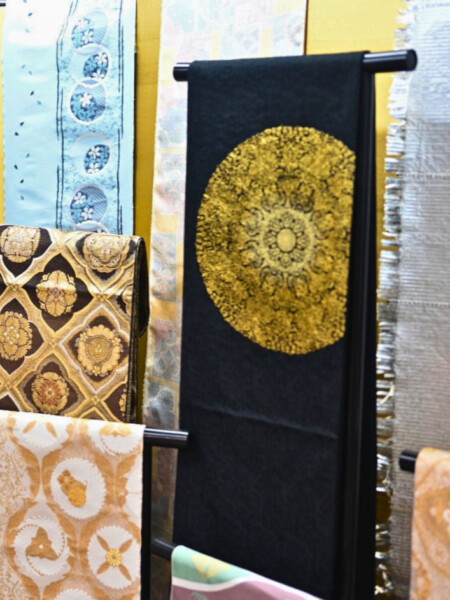
On your third morning in Kyoto, as you pause before a shop window in Nishijin, the obi hanging there seems
to shift colour when a cloud slides past the sun. You don’t ask why, not yet. That answer comes later, one
thread at a time.
This is the history of a textile. More than that, it’s a story about a way of seeing; one that has almost nothing to do with speed, and everything to do with what happens when you finally stop looking for it.
This is the history of a textile. More than that, it’s a story about a way of seeing; one that has almost nothing to do with speed, and everything to do with what happens when you finally stop looking for it.
A Name Written by Fire
The word “Nishijin” means, quite literally, “western camp.” It refers to the position of the western
army during the Ōnin War, the decade of fighting in the late fifteenth century that left much of Kyoto
in ashes. The city’s weavers scattered during those years, and when the war finally ended, they
returned to this very district to start weaving again, on the same ground where an army had once
stood.
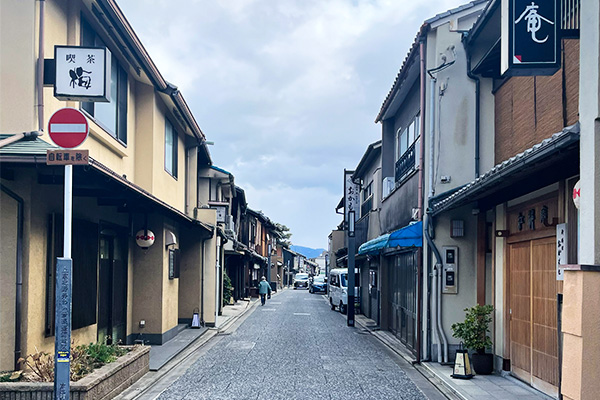
You could walk past without noticing this history. Nothing about the quiet lanes of Nishijin today
announces “battlefield.” Yet, it is worth knowing that the textile you are about to encounter
doesn’t simply have old roots: it has a rebirth date. Kyoto burned more than once, and what you see
now is what grew back. The looms of Nishijin are one of the places in the city where that pattern of
loss and return is written into a name and worn on a shoulder.
As the Edo period consolidated, the district organised itself into something more deliberate than a
scattered return: a system of specialised trades, each refining a single stage of the work, which
raised both the output and the precision of what the looms create. That structure is, in essence, the
one still used today and old enough that the Japanese government has formally designated and
recognised it as a traditional craft. One flexible enough that its output now stretches from bridal
kimono to Noh costume and necktie silk.
Where to Begin
If you want a broad view first, the Nishijin Textile Center is your natural starting point and a short
walk from Imadegawa Station. Free to enter but closed on Mondays. Inside, looms and displays lay out
the craft’s essential shapes: what Nishijin-ori is, the number of centuries it has been woven, how far
its reach extends beyond the kimono and obi most visitors expect, into altar textiles, Noh robes, and
the brocade used in temples and shrines across Japan. A kimono show runs at set times in the main
hall, a charming enough spectacle, albeit not the reason you came.
Treat it as an introduction, not a destination. It will explain what Nishijin-ori is but it won’t yet
tell you how to see it. For that, you must delve a little deeper into the district, where the actual
work still happens behind ordinary doors.
A Conversation in Silk
Here is the part that surprises most people: no single workshop, and no single weaver, makes a piece
of Nishijin-ori from beginning to end. One person draws the design. Another translates that design
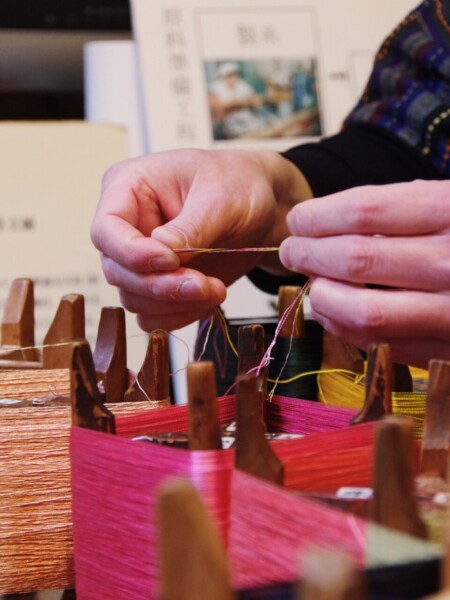
into the data the loom will read. Someone else dyes the thread, with sometimes as many as fifty or
more separate colours for a single pattern. Someone prepares the warp threads with the patience of a
person threading a needle in the dark. Another readies the weft, which may include threads of beaten
gold or silver leaf, laid onto washi paper, cut into hair-thin strips, and hooked one at a time onto
the loom by a craftsperson who does nothing else. Then, finally, someone weaves. And after that,
someone finishes. Europe has its own memory of this kind of guild specialisation — the ateliers behind
a Gobelins tapestry, the trade halls of a medieval weavers’ guild — though few such systems have
survived, intact and still working, as long as this one has.
No one has ever managed to count, with any confidence, how many hands touch a single obi before it is
finished. That is not a gap in the record-keeping. It is the nature of the thing. What you are
holding, when you hold a piece of Nishijin-ori, is a conversation between people who may never have
met each other — a designer who never touched a loom, and a weaver who never saw the drawing take its
first shape on paper.
Some of these conversations are going quiet. The gold-leaf weft is prepared by specialists using a
technique called hikihaku — a slow, exacting handcraft that, by the craft industry’s own account,
employed some forty artisans in the city as recently as fifty years ago. Today, only a handful remain.
If you come to Nishijin looking for a single craftsperson to represent the whole trade, you will fail,
because the trade was never built to have one. It was built to need many; and some of those many are
disappearing faster than others.
None of what follows requires a child in tow — the same slow task works just as well between two
adults with nothing to prove to each other, or a solo traveller sharing a bench with a stranger. But
if you are travelling with family, there is something here worth knowing. Several of the small
hand-weaving experiences around the district: a table runner, a coaster, a woven strip of silk you can
take home the same afternoon — are designed for children roughly eleven or twelve and older. This
makes them perfect for a family with teenagers, or with grown, college-age kids rather than with
toddlers. It is a small thing: two generations sitting at the same loom, passing a single shuttle back
and forth, learning together how much patience one centimetre actually requires. Yet, it is one of the
few moments in a day in Kyoto where a parent and a nearly-grown child — sixteen or twenty-six, it
hardly matters — carry out the same slow task, side by side, with nothing to compare and nowhere to
rush to.

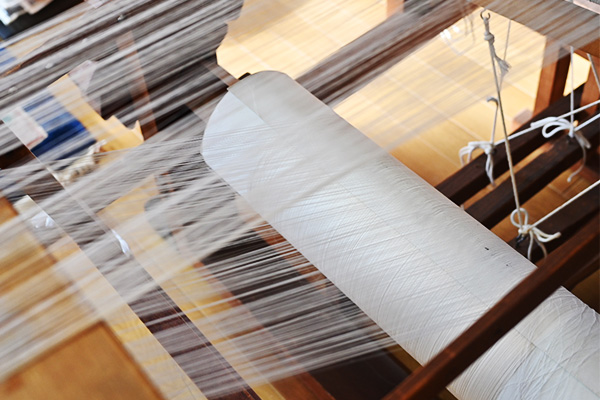

One Centimetre a Day
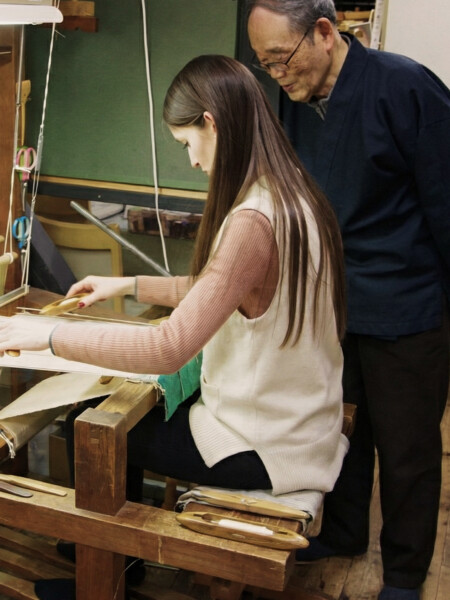
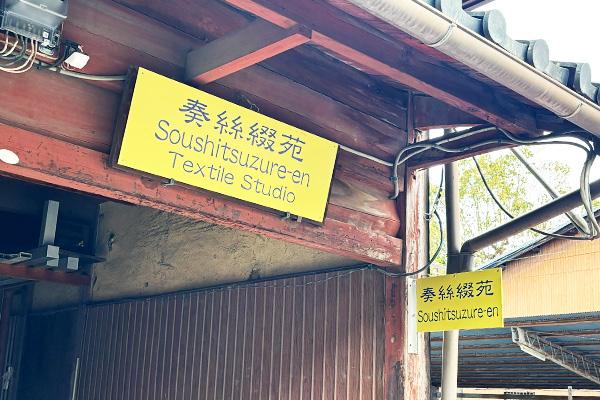
In the neighbourhood of Kamishichiken, in a workshop called Sōshi Tsuzureen, a weaver named Kikuo
Hirano works in a technique called tsuzure-ori — hand-woven tapestry silk, made without the help of
a
mechanised loom. The third generation of his family to do this. He began, as a child in that
household, with ten years of daily practice before he could attempt anything of scale, and later
spent
decades working within a larger textile company before returning to this particular craft as the
path
he was destined for.
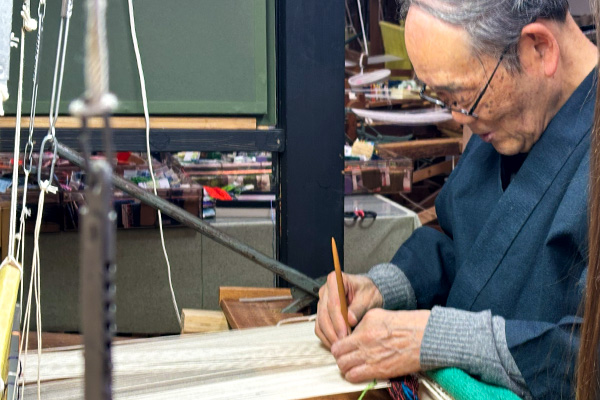
The technique itself has a name that describes exactly what the hands are doing: tsume-gaki, or
“claw-scratching.” Hirano notches his fingernails into small saw-teeth and uses them, instead of a
shuttle mechanism, to gather the weft threads into place, one pull at a time. There is no template
that fixes the outcome in advance. The design exists as a guide, not a blueprint: the colour and the
exact shape of each motif are left to the weaver’s judgment in the moment, which means that no two
tsuzure-ori pieces, even from the same drawing, are ever quite identical. On a complicated pattern,
the work can advance by as little as a single centimetre in a day.
Say that once more, slowly: a centimetre. Not a section. Not a panel. A width you could cover with a
fingertip, and that is a full day’s labour for a person who has spent a lifetime becoming fast at
being slow.
In a published interview with Kyoto Artisans Concierge, Hirano’s atelier described its own aim as:
“During a visit to the atelier, even if it is only for an hour, we let the visitors discover the beauty of tsuzure-ori. We help them create the work of their choice and aim to give them a fulfilling experience.”
Not a lecture. Not a sales pitch. A discovery, made in an hour, for something that takes a lifetime to master. It is a generous ambition, and an unusual one: most people who devote a life to a single centimetre a day are not eager to reduce it to sixty minutes for a stranger. By its own account, Hirano’s atelier is one of them, with workshops for beginners as much as connoisseurs, whatever your age or your prior experience with a loom.
“During a visit to the atelier, even if it is only for an hour, we let the visitors discover the beauty of tsuzure-ori. We help them create the work of their choice and aim to give them a fulfilling experience.”
Not a lecture. Not a sales pitch. A discovery, made in an hour, for something that takes a lifetime to master. It is a generous ambition, and an unusual one: most people who devote a life to a single centimetre a day are not eager to reduce it to sixty minutes for a stranger. By its own account, Hirano’s atelier is one of them, with workshops for beginners as much as connoisseurs, whatever your age or your prior experience with a loom.
If you spend enough time in Nishijin, you will learn that there’s living National Treasures working
in related Nishijin weaving techniques. People recognised by the state for holding craft-skills that
might otherwise vanish. Hirano himself doesn’t hold that particular title; what he stands on instead
is three generations of inherited technique and a lifetime spent learning what a single centimetre
is worth. That recognition exists elsewhere in Nishijin, and it matters, but it is not really the
point of an afternoon here. The point is smaller and, somehow, larger: one person, one workshop, one
hour, one centimetre — multiplied, if you let it, into a completely different sense of what “fast”
and “slow” actually mean.
What the Light Reveals
Nishijin-ori is a pre-dyed textile. The threads are coloured before ever being placed on the loom, and
the pattern that appears is not printed onto the surface afterward. It is built, thread by thread, out
of the exact combination of warp and weft, twist and sheen, gold leaf and silk, chosen and arranged in
advance. Nothing sits on top of the fabric. The pattern is the structure.
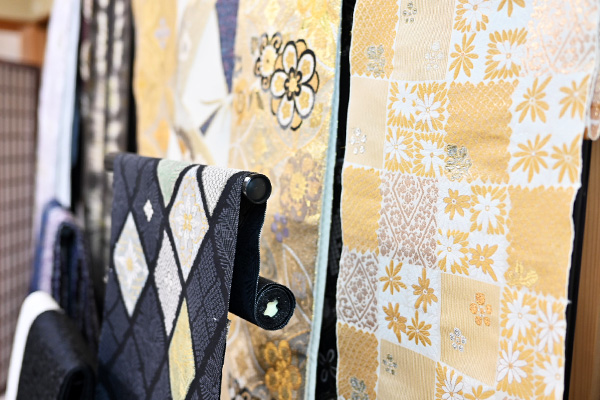
This is why the colour moves. Turn the same obi ten degrees toward a window, and the gold thread that
looked quiet a moment ago suddenly catches the light and the whole piece seems to shift in tone; not
because anything about the object has changed, but because you have. This is not a trick of the eye so
much as a property of the weave itself: light behaves differently against silk laid at different
angles, and a textile built from many different threads, each with its own twist and reflectivity,
will always have more than one face.
The first time you see this, in a shop or a workshop window, it registers as a pleasant surprise.
The third time, on a return visit, months or years later, standing in front of the same or a similar
piece in a different season’s light, it becomes something closer to a private joke between you and
the fabric. You start to expect the shift. You start to look for the angle on purpose. This is, in
miniature, the entire experience of returning to Kyoto: the city does not change so much as your
ability to notice it does.
The Patience You Take Home
None of this: the fire that gave the district its name, the conversation between hands that never
meet, the single centimetre, the light that moves across gold thread — asks you to buy anything or
learn anything by heart. It asks only that you slow down enough to notice it, which is, in its own
way, the most valuable thing Nishijin has to offer people who otherwise measure their days in
efficient use of time.
There is a version of this visit that fits into an afternoon, and a version that opens into something
much longer: a conversation with a weaver, a second visit, a piece commissioned rather than bought.
Which version you have access to, and when, is not really something a guidebook can arrange for you.
That part, finding the right hour, with the right person, at the right door — is something we’d be
happy to work out with you.
Before You Go
Details such as opening hours, fees, and age requirements change; the figures below
are a general guide. Please confirm specifics with each workshop, or let us confirm them for you,
before your visit.
A few practical things to take into account: most of these are working studios, not museums, so ask
before you take a photo and keep your voice low, the way you would in any small home workspace. Shoes
are expected to come off if you step onto tatami. It’s also worth carrying some cash. Several of these
are small, family-run operations that, like many such studios in Japan, may not take a card as readily
as the larger stops on this list.
| Place | What it is | Basic hours / access | Reservation | A note from us |
|---|---|---|---|---|
| Nishijin Textile Center | The general introduction to Nishijin-ori — displays, looms, and a kimono show. A short walk from Imadegawa Station. | Roughly 10:00–16:00. Closed Mondays (and the following Tuesday if Monday is a holiday), and over the New Year. Free entry. | Not required to enter; hand-weaving and dress experiences are ticketed separately. Booking may be required. | A good first hour, not a full afternoon — the kimono show’s exact times are worth a quick check on the day. |
| Orinasukan | A 1936 weaver’s townhouse turned hand-weaving museum, with a working loom area and Noh costume collection. | Opening hours are best confirmed directly with the museum before your visit. | Recommended in advance for the weaving experience. | The building itself — the old weaver’s home — is half the story. |
| Tomiya Orimono (Tate to Yoko Workshop) | A long-established obi workshop that opens its working floor — jacquard and traditional hand looms — to small groups. | Sessions run several times daily; roughly 90 minutes. From around ¥4,000, though it’s worth reconfirming the figure when you book. Suitable from around age eleven. | Required, several days ahead. | One of the few places you can watch a working loom in motion, not a demonstration of one. The room holds up to six, so a group of four adults fits with room to spare. |
| Sōshi Tsuzureen (Kikuo Hirano’s workshop) | The tsuzure-ori workshop of a third-generation weaver, in the Kamishichiken district. | Open roughly 10:00–17:00, with irregular closures. A studio tour alone runs about an hour, from roughly ¥1,000 per adult; a small hands-on piece — a coaster, say — runs about three hours, from roughly ¥5,500; a full day at the loom runs about six hours, from around ¥12,000. Treat these as a starting range rather than a quote. | Required — please let us help arrange this, including timing, group size, and any language support. | The heart of this story. The hands-on loom seats two to four people weaving at once, so a small group is welcome, though the full-day and lampshade sessions are limited to one or two — worth flagging your numbers when we book. Beyond the figures above, this is a workshop best worked out with us directly rather than assumed from a website. |
| Obiya Sutematsu | A long-standing Nishijin weaving house offering limited-date tours of its hand-weaving workshop and townhouse. | Held on select dates only — worth asking us to check the current calendar before you plan around it. | Required. | Worth asking us about if your visit dates happen to align. |
A Nishijin Morning — A Model Route
A half-day, roughly three to four hours, mostly on foot. This is not a route built for
covering ground quickly. It’s designed for spending real time on one thing.
1. Start at the Nishijin Textile Center
(30–40 minutes, free)
get your bearings for the district and the craft in broad strokes.
2. Walk the back lanes of Nishijin
(about 15 minutes)
— listen for the sound of looms still running behind ordinary house fronts.
3. Visit a working workshop
— Tomiya Orimono or Orinasukan (60–90 minutes)
to see hands actually at work, not a display of hands at work.
4. Continue on to Kamishichiken
(about an hour, or longer if you’ve arranged a hands-on piece)
for a visit to Sōshi Tsuzureen. Ideally arranged in advance, with our help.
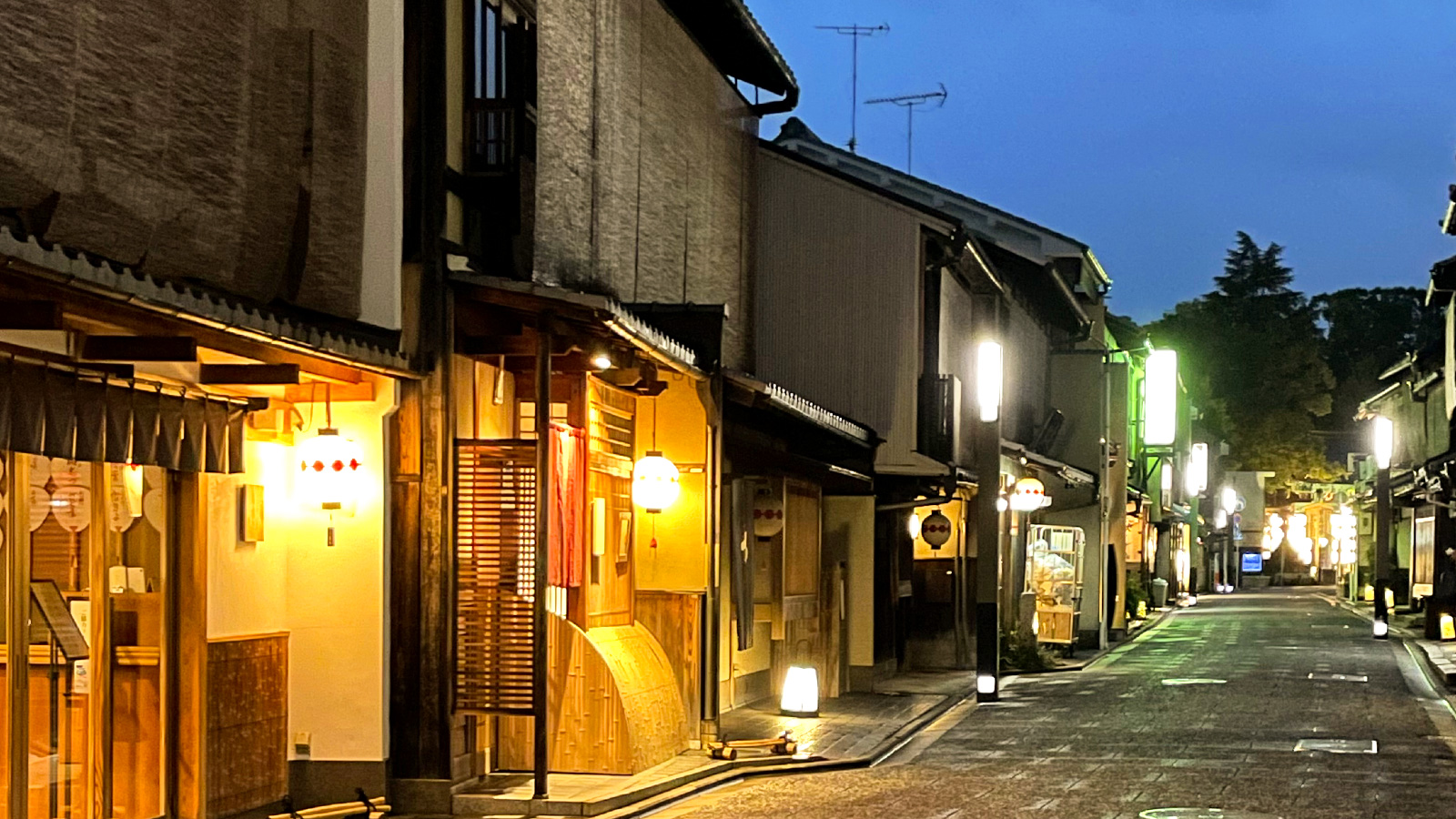
5. Finish in the Kamishichiken teahouse street
for coffee and a quiet moment, with no further schedule for the rest of the
afternoon.
Sharing Kyoto Exclusive Nishijin Silk Tours